
Our mission is to help eliminate unknown fixing failures
The launch of ais follows our first-hand multi-sector experiences of the far-reaching problems that unidentified fixing failures cause, including reduction in profits, loss of revenue and increased risk exposure.
Our technology identifies fixing cracks, failure and beyond-threshold wear. It reduces dependency on physical inspections and facilitates preventative maintenance to reduce premature part replacement.
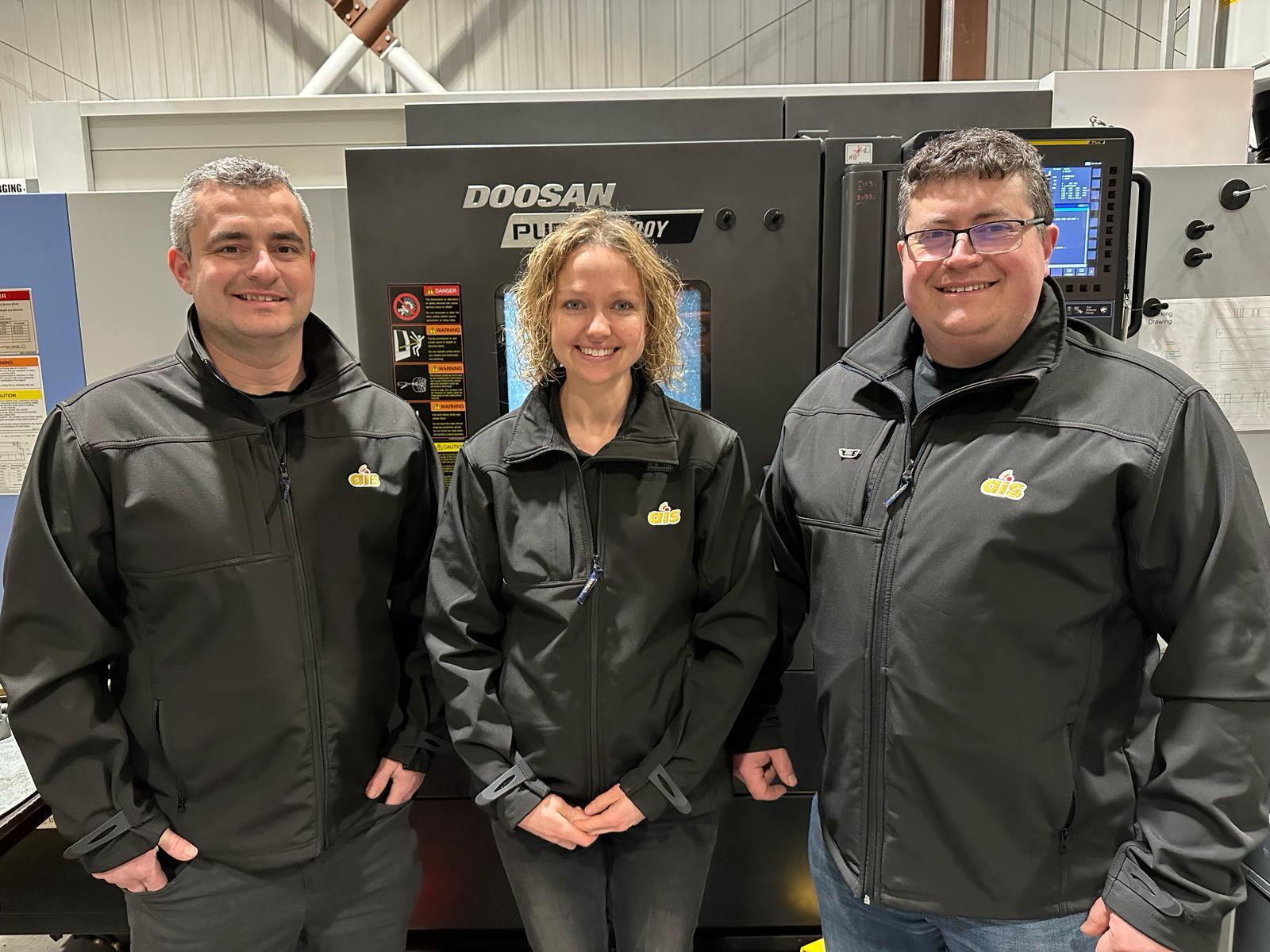
Above: Operations Director, Calvin Anstee; Commercial Manager, Ceri Anstee; Managing Director, Craig Anstee
Our story
Anstee Indication Systems (ais) evolved from Anstee Tree Felling; a company run by Craig and Calvin with decades of engineering-focused experience in the forestry and recycling sectors. The experiences and lessons learned operating chippers and shredders within Anstee Tree Felling ultimately led to ais.
Background to the problem driving the development of self-checking pin technology
Anstee Tree Felling provides a market leading nationwide shredding and grinding service of up to 100 tonnes per hour with its CBI Magnum Force 5400T Horizontal Grinder. The grinder reduces and recycles a wide range of materials, including all types of wood and waste. While the performance of the grinder is as expected the company faced two issues:
1. The process of checking pins for failure after hitting feedstock contaminated with metal was time consuming and costly. As an arduous task in unpleasant conditions, employees often took a chance and skipped it to save themselves time and effort.
2. Undetected failed pins ultimately led to damage to the grinder, causing an unscheduled, costly halt to operations.
The metal strike operating procedure
The grinder is fitted with a metal detection system (MDS), which is a safety feature that automatically shuts the machine down as soon as a metal strike of an impact magnitude in excess of the MDS trip point occurs. The MDS is designed to protect further damage to the shear pins in the grinder, initiating shut down to allow the operator to follow operating procedures by checking the pins for any sign of failure.
The process of checking pins is a difficult task which takes around 40 minutes. Each of the four 15kg pins needs to be removed from the grinder with heavy hand tools and inspected. If a damaged pin is found it must be replaced immediately, but hitting metal does not necessarily guarantee pin failure; sometimes the pins do not incur damage and can be reused.
Crucially, if failed pins are not replaced, the machine is very likely to subsequently incur further damage. This is because the pins support the grate frame and anvil that the rotor strikes against. Unsupported, the grate frame can twist in the hog box and leave the machine unusable.
How often the MDS shuts the grinder down depends on the level of metal contamination in the feedstock. This could be as little as once or twice a week or every ten minutes of operation. While the MDS can help prevent damage, the system isn’t perfect. Pins get cracked during a metal strike that cannot always be detected by a visual inspection and then go on to fatigue fail during normal operation, unknown to the operator. This means grinding can go on for a full shift or more, causing damage without any further metal strikes.
The significant costs of a metal strike
One of the biggest issues Anstee Tree Felling faced was that employees were often reluctant to stop and check the pins. Willing to take the risk, they often ignored the MDS alert. They turned the machine back on and continued grinding. Inevitably, this subsequently leads to grate frame damage which incurs tens of thousands in costs.
The costs arise in multiple ways. Firstly, there’s the financial costs associated with the damage. Costs include replacement non-consumable parts with long lead-times, transportation of the 40 tonne grinder to and from the repair base, and the associated haulage and repair labour. Secondly and significantly, the damage inevitably delays the operations, often with financial costs and knock-on delays to subsequent jobs. Every day of lost operation costs thousands of pounds; far more than the cost of the damage itself.
As the business grew, it became increasingly challenging for Craig and Calvin to accept the losses incurred as a result of the operator failing to stop work and check the pins after hitting contamination.


The cost and inconvenience of precautionary checks
And this wasn’t the only frustration: precautionary pin checks are time consuming and costly. It slows the job down, increases costs and reduces efficiency. A key challenge was managing client relations. These are liable to fraying when operators are diligently following the operating procedure and undertaking a 40-minute pin inspection as frequently as the MDS activates.
Since the grinder is charged per hour, including for time spent checking pins, naturally, their priority is getting their material processed as quickly as possible. Frequent pin checks can therefore ultimately lead to the loss of the client.
Moreover, while precautionary checks were essential, pin damage isn’t always visible. Sometimes significant grid damage arose despite diligent pin inspections taking place.
Finding a better way
Craig and Calvin initially sought to buy an off-the-shelf solution to reduce downtime and losses associated with the damage caused by undetected failed pins. However, their exhaustive searches led them to the conclusion there was no product or solution; there was no way to know if and when pins had failed.
With no other alternative, they set out to design, develop and patent an innovative fixing failure indication system. This system would not only eliminate the risk of failed fixings going unidentified, but eliminate the need for operators to manually check fixings for signs of failure.
Outcome
Following extensive research and development, including years of testing and refinement, Craig and Calvin established Anstee Indication Systems Limited (ais) in 2022 to take their concept through to commercialisation.
Contact us today
For more information, please call 01656 331517 or email info@ansteeindicationsystems.co.uk.
Alternatively, use our online enquiry form.
Send us a message